
Aurum Apex Biolabs | Research Journal
Two important measurements in peptide analysis — but what does each one actually tell us?
What Is the Difference?
When evaluating peptides in a laboratory, two important concepts are purity and identity.
Although they are often mentioned together, they describe different characteristics of a sample.
- Purity: Measures how much of the detected material is attributed to the main component under a particular analytical method.
- Identity: Helps establish whether the substance is actually the intended molecule.
Understanding both is essential when interpreting laboratory reports and Certificates of Analysis (COAs).
1. Understanding Peptide Purity
Purity refers to the proportion of the measured sample signal attributed to the primary component.
One commonly used technique is High-Performance Liquid Chromatography (HPLC).
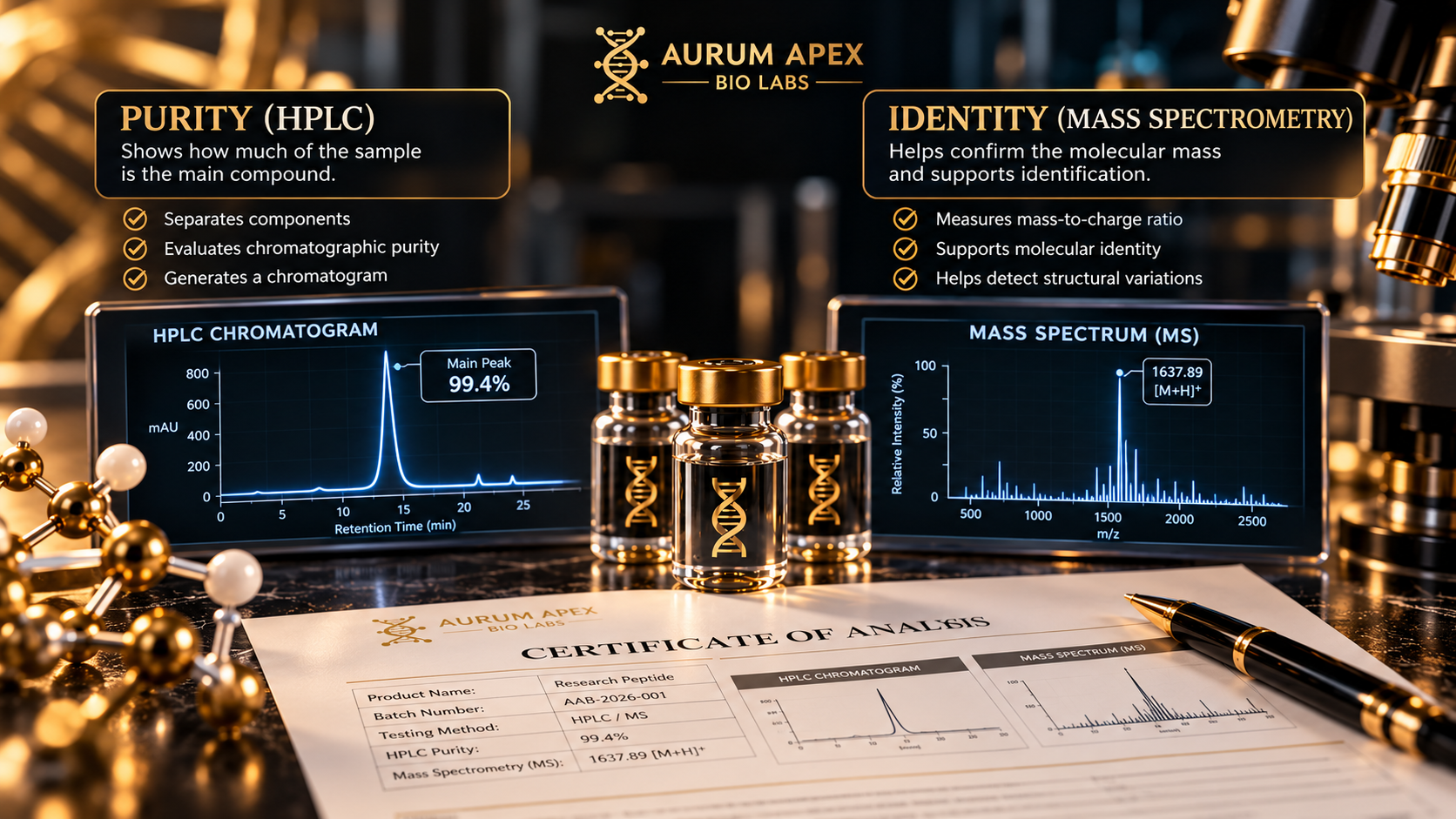
HPLC separates different components and produces a chromatogram containing peaks.
A report might show:
99% HPLC purity
This generally means that approximately 99% of the measured chromatographic peak area is attributed to the main component.
However, this does not necessarily mean 99% of the sample’s total weight is the target peptide.
2. Understanding Peptide Identity
Identity answers a different question:
Is this actually the molecule it claims to be?
Scientists may use Mass Spectrometry (MS) to measure molecular mass and support identification.
Depending on the analytical approach, additional techniques may help confirm the amino acid sequence and detect structural modifications.
Identity testing is important because a sample can have a dominant chromatographic peak without that result alone proving the complete molecular identity.
3. Why Both Measurements Matter
Imagine two samples:
- Sample A has a dominant HPLC peak but has not undergone sufficient identity testing.
- Sample B has a similar HPLC result and supporting mass spectrometry data consistent with the intended molecule.
The additional identity evidence provides a stronger basis for evaluating Sample B.
This illustrates why purity and identity should be considered together rather than treating one measurement as proof of everything.
4. Which Laboratory Tests Are Commonly Used?
Two important analytical methods include:
HPLC
- Separates sample components.
- Helps evaluate chromatographic purity.
- Provides retention times and peak areas.
Mass Spectrometry
- Measures mass-to-charge ratios.
- Helps evaluate molecular mass.
- Supports molecular identification and characterization.
Additional analytical methods may be needed depending on the compound and the research requirements.
5. What Should You Look for on a COA?
When reviewing a Certificate of Analysis, consider these details:
- Compound name and batch number.
- Reported HPLC purity and analytical method.
- Mass spectrometry results.
- Testing laboratory information.
- Testing date and sample traceability.
- Any limitations or qualifications included in the report.
A clear, traceable report is more informative than a document displaying only a purity percentage.
Conclusion
Peptide purity and identity are two different but complementary aspects of laboratory analysis.
Purity helps evaluate the composition of a sample, while identity testing helps determine whether the intended molecule is present.
At Aurum Apex Biolabs, we believe that understanding the difference between these measurements helps promote better scientific literacy and more informed interpretation of laboratory results.
The key takeaway: High purity does not automatically confirm identity. Both matter when evaluating peptide research materials.
Educational disclaimer: This article is for scientific and educational purposes only. It is not medical advice and does not establish the safety or efficacy of any specific compound.

